
Case studies · 17
Character Interaction Multiplayer Framework
Making a difficult multiplayer conversion safer to diagnose and change
Character Interaction was a tightly coupled single-player Unreal Engine system being converted for multiplayer use. Marc’s contribution was not to claim the deepest networking expertise, but to make the distributed technical work more reliable through source control, structured diagnosis, research, testing and careful coordination with specialists.
- Project provenance
- Independent / collaborative R&D
- Delivery context
- Founder-led distributed technical collaboration · Specialist implementation by multiple contributors
- Period
- 2018–2019
- Disciplines
- R&D · Development
At a glance
Character Interaction Multiplayer Framework
How source control, structured diagnosis, testing and specialist collaboration helped move a tightly coupled Unreal system towards a multiplayer-ready milestone.
At a glance
- Period: 2018–February 2019
- Core challenge: retrofit multiplayer replication into interconnected single-player systems
- Marc’s role: technical operations, collaborative diagnosis, research, testing and systems coordination
- Specialist collaboration: included Unreal networking specialist Raed Abbas
- Outcome: work reached a public completion milestone and directly led to the MESH Interactive collaboration
The full story
Making a difficult multiplayer conversion safer to diagnose and change
Retrofitting multiplayer into a system designed around one local player is rarely a matter of adding a few replicated variables.
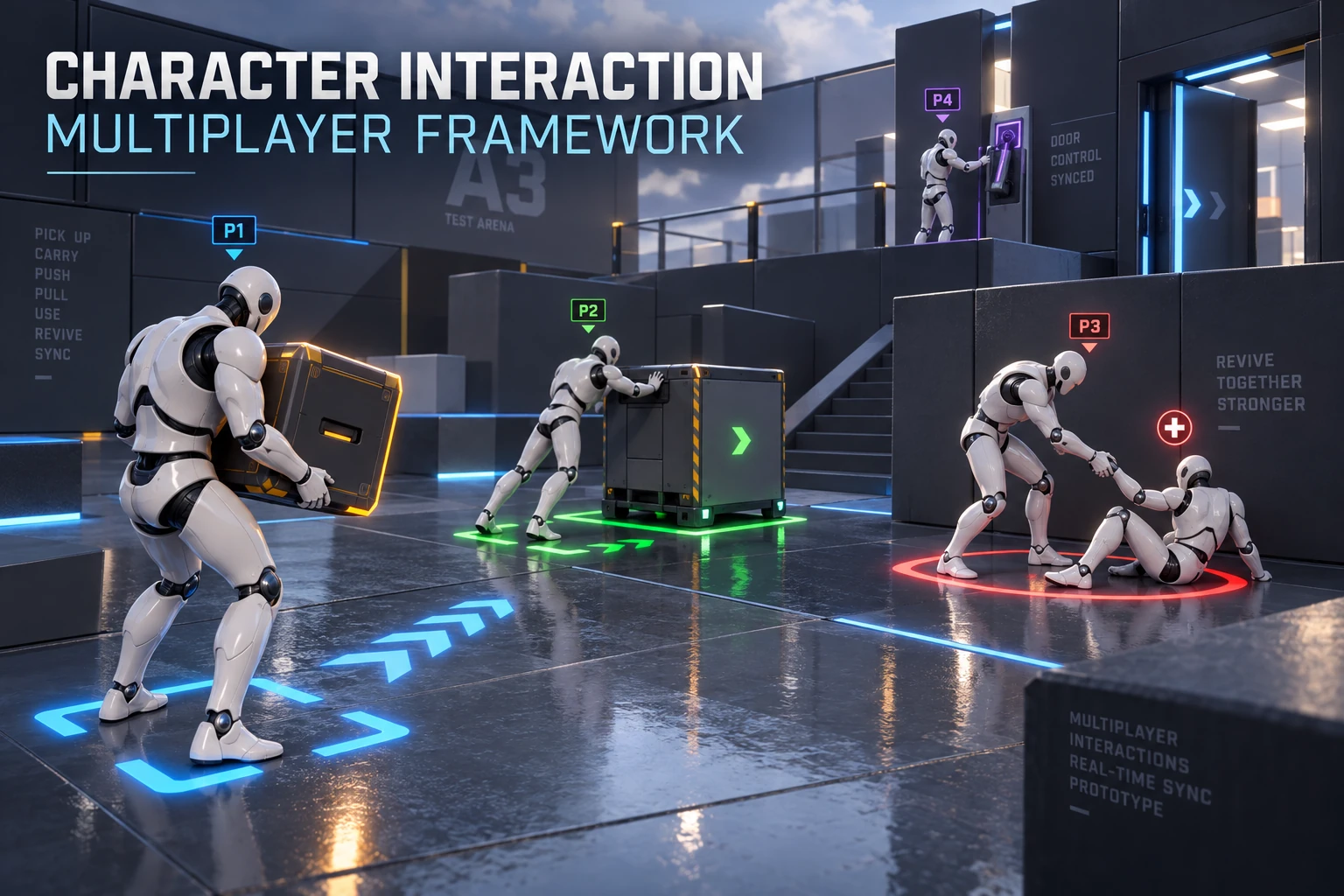
Character Interaction 3 had interconnected player, interaction, weapon, bot and vehicle logic built around single-player assumptions. The collaboration aimed to refactor that behaviour into a multiplayer-ready framework integrated with Advanced Locomotion, including camera transitions between first and third person.
The visible bugs could be misleading. A weapon might look correct for one player and remain attached incorrectly for another. An interaction that worked locally could fail for a remote client. Blueprint logic that made perfect sense in a single-player context could behave differently once authority, ownership and replication were involved.
Marc Thornton joined the distributed collaboration in 2018. He briefly stepped away when the remaining work appeared close to completion, then returned in late November when difficult problems were still unresolved.
One important change was bringing Raed Abbas into the active work around a persistent melee and held-weapon issue. Raed quickly demonstrated deeper specialist skill in Unreal networking and replication. Marc’s role became complementary rather than competitive.
He concentrated on making the working environment safer and the reasoning more explicit.
Shared source control and reliable working environments mattered because several people were changing tightly connected systems. A failed experiment had to be reversible. Useful discoveries made before that experiment had to be preserved. Different theories about a bug needed a reproducible baseline from which they could be tested.
Marc therefore focused on versioning, backup, access, security and the everyday operational discipline required to stop the collaboration becoming fragile.
He also developed a deliberately simple debugging habit: step backwards.
When the team became stuck, the questions were not “what clever thing can we try next?” but “what do we actually know?”, “what have we observed rather than assumed?” and “at exactly what step does the real behaviour diverge from the expected behaviour?”
Walking through those flows with the specialist responsible for them often exposed assumptions that had become invisible through familiarity. The objective was not to take ownership away from the engineer. It was to give that engineer another way to interrogate the problem.
That approach worked particularly well with Raed. Raed could focus deeply on the networking implementation while Marc researched unfamiliar issues, tested assumptions, documented what had already been learned and broke larger failures into smaller questions.
Through December, the collaboration touched Perforce, weapon replication, melee behaviour, multiplayer testing and network jitter. At the same time, Marc and Raed began discussing whether the lessons could be turned into a more reusable architecture instead of repeatedly solving similar integration problems from scratch.
On 8 December, Marc proposed a cleaner framework centred on locomotion, interaction and multiplayer-ready components. That discussion became MESH Interactive.
The Character Interaction work continued alongside it. On 21 February 2019, Marc publicly described the conversion work as finally finished, coinciding with the MESH teaser that demonstrated the broader capability arising from the collaboration.
The case study is useful precisely because Marc was not the strongest networking programmer in the room. Raed and the other contributors deserve the specialist implementation credit.
Marc’s value was in improving the conditions around that expertise: safer versioning, clearer evidence, better questions, preserved progress and enough structure for specialists to solve the hard parts without repeatedly losing ground.
That is a pattern Digital SHIFT still uses in complex technical work. Good coordination is not a substitute for expertise. It is what allows the right expertise to remain productive when several systems, people and assumptions are colliding at once.
Something to untangle?
Let’s discuss the real problem.
If this case study sounds close to a situation you are facing, send me a short outline.
Email Marc