
Case studies · 04
Custom Marine
Connecting production, quality control and client reporting in one platform
Custom Marine initially appeared to need an app. Discovery showed that the real problem was larger: orders, scheduling, fabrication, treatment, QA, sign-off and client communication all needed to connect. The result was a shared operational platform built around the way the business actually worked.
- Project provenance
- Client project
- Delivery context
- Founder-led project delivered through SKYLAB
- Period
- 2018–2021
- Disciplines
- Featured · Commercial · Development · Design
At a glance
Custom Marine
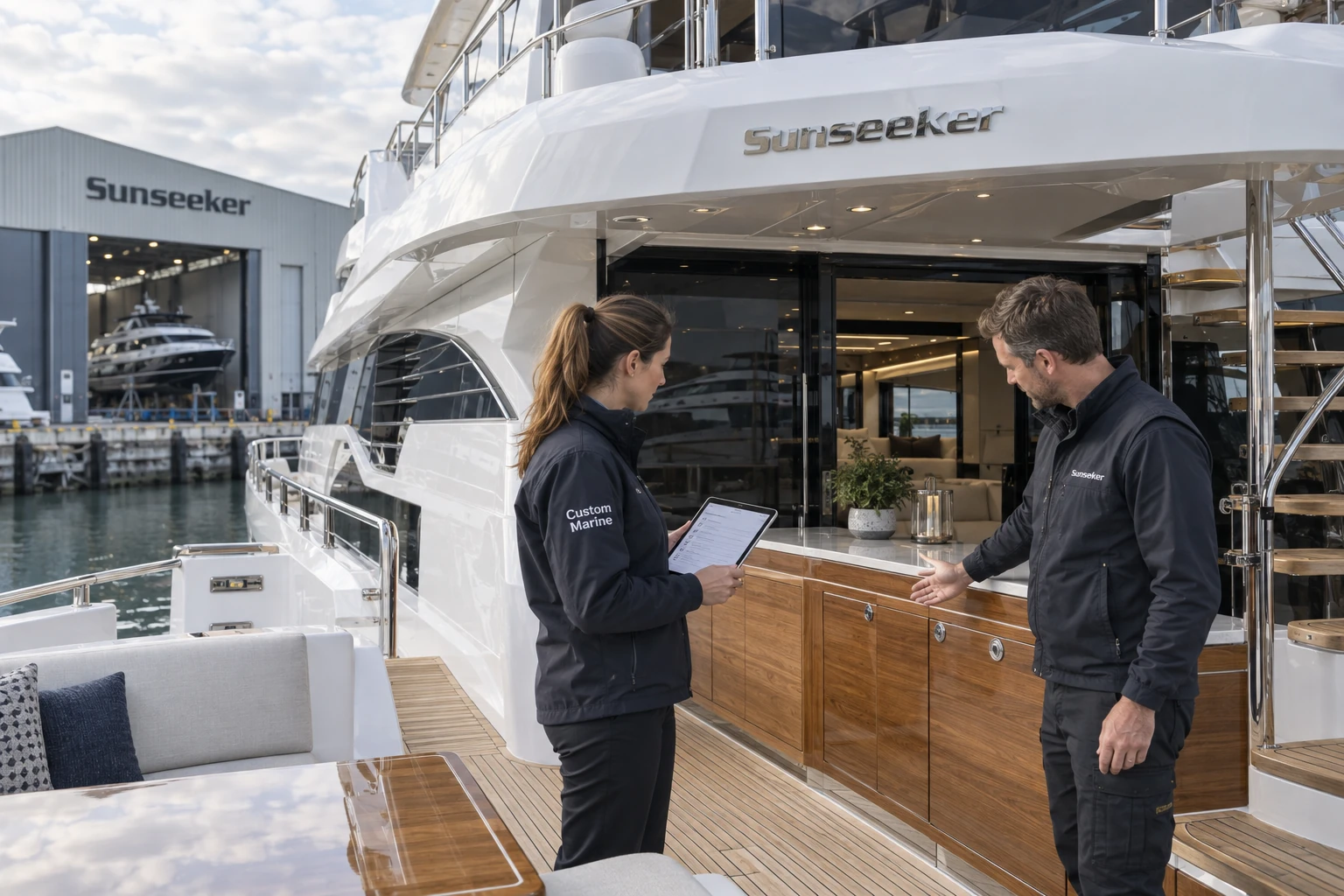
How a simple app brief became an integrated production, QA, management and client-reporting platform supporting Custom Marine’s Sunseeker relationship.
Problem
An initial app brief concealed disconnected orders, production, quality checks, approvals and client reporting.
Intervention
Through SKYLAB, Marc led discovery and workflow mapping with the client and technical lead, defining a phased platform with production-floor and management views of shared data.
Outcome
Touchscreens and tablets supported progress, QA and sign-off; management gained operational visibility and an audit trail. Restricted client access let Sunseeker monitor relevant project information.
The full story
Connecting production, quality control and client reporting in one platform
When Custom Marine secured the opportunity to work with Sunseeker International, production capacity was only part of the challenge. The business also needed processes and reporting robust enough for the scale, quality and accountability expected by a major luxury yacht manufacturer.
The opportunity came through SKYLAB, the software business created by Digital SHIFT founder Marc Thornton. Marc led the engagement from the outset, researching the operation before the first meeting, running discovery with the client and mapping where disconnected processes were creating friction.
The initial conversation centred on an application. The deeper requirement was an end-to-end operational system.
A confirmed order needed to move through specification, scheduling, fabrication, treatment, quality checks, approvals and delivery. People on the production floor needed a simple view of what to do next. Managers needed visibility across jobs, capacity, deadlines and exceptions. Senior management needed the commercial picture. Eventually, the client also needed controlled access to relevant information.
The product therefore had to present different views of the same underlying data without creating several competing versions of the truth.
Marc mapped the user journeys and translated physical production processes into usable digital flows. Working with the technical lead, he turned those workflows into a detailed scope and phased implementation plan, linking each proposed component back to a specific operational problem.
The platform was designed around two main interfaces connected to a secure, real-time backend.
On the production floor, touchscreen devices at individual work bays and tablets used by managers needed to make actions obvious and quick. Staff could see requirements, record progress, flag issues and complete quality and sign-off stages without turning the software itself into another bottleneck.
For management, the interface focused on orders, capacity, production status, deadlines, exceptions and delivery. Both sides worked from the same underlying information.
Traceability was designed in from the start. Changes, approvals and decisions could be recorded against individual jobs, including whether a change originated internally or from the client. That made it easier to understand why a specification, cost or delivery date had moved without relying on scattered emails or somebody’s memory.
The team continued refining the product after it reached real users. Workflows and interfaces were adjusted from practical feedback, and the platform was later extended with restricted client access so Sunseeker could monitor relevant project and delivery information directly.
The outcome was not simply a custom software build. It was a clearer operating system for a growing manufacturer: better hand-offs, stronger visibility over capacity and delivery, more accountability, and an auditable trail through the production process.
It also helped Custom Marine demonstrate the operational maturity required to support its relationship with Sunseeker.
This project is a strong example of why we do not take an initial software request too literally. Sometimes the thing a client asks for is only the visible edge of the problem. Good discovery finds the workflow underneath it before development money is committed to the wrong shape of solution.
Something to untangle?
Let’s discuss the real problem.
If this case study sounds close to a situation you are facing, send me a short outline.
Email Marc